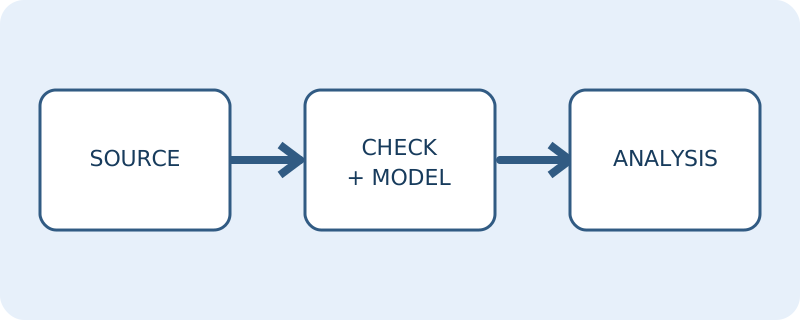
Understanding Data Engineering and Its Workflow
Follow sample transactions from their source to a table ready for analysis.
Hello, I’m the writer behind alfianh.id. Here I collect notes on how data moves from its source to something useful for making decisions.
I work through small examples: transactions that need cleaning, transformations that need tests, and jobs that must be safe to repeat. Start with foundations, then examine design choices and their failure modes.
Author identity is a preview. Articles and data on this site are learning samples.
Find a learning pathAn editorial selection: understand the concept, try SQL, then think about recovery.
Follow sample transactions from their source to a table ready for analysis.
Normalize missing identifiers, choose a deterministic duplicate winner, and reconcile rejected transactions.
Use a business key and source revision to make a destination update safe to replay.
9 published articles in English
In publication order. Different reads from the editorial selection above.
Browse the archiveA small sample for checking technical prose and bilingual publishing.
Reason about partition order, consumer groups, offsets, and duplicate delivery using a small event log.
Connect a model with ref, test its business key, and review incremental correctness separately.
Follow data from its source through cleaning and ETL to an analytical model.
4 ordered articles
Be comfortable reading tables. For the Python exercise, have Python 3 and basic knowledge of functions.
Connect scheduling, transformation tests, and safe replay.
3 ordered articles
Finish Foundations or be comfortable with SQL, Python functions, ETL, and dimensional models.
Illustrative case study: synthetic transactions, quality checks, quarantine, and batch recovery. No client or business impact claims.
Explore the synthetic transaction pipeline